Tuesday, July 03, 2007

THE MDG AND POVERTY IN BURKINA FASO


We have approached the mid-point for the Millennium Development Goals (MDG) and progress to date varies according to the 2007 MDG report. Although some nations in Sub-Saharan Africa have witnessed positive improvements in specific areas, "the lack of any significant increase in official development assistance since 2004 makes it impossible, even for well-governed countries, to meet the Millennium Development Goals," U.N. Secretary-General Ban Ki-moon said last Monday. The report further states that “donors should reduce the present unpredictability of aid by providing multi-year schedules of aid flows to each recipient country.” This report also urges the developed countries particularly the Group of the Eight most industrialized nations to meet their pledge to double aid to Africa by 2010.

One African nation desperately in need of this additional aid is Burkina Faso, one of the poorest countries in the world where the majority of the 13 million people live on less than $1 a day.

In an article entitled “A Century Behind” appearing in the January 16, 2006 issue of The National Catholic Weekly, Peter Donaldson, President of the Population Council, states, “Mortality rates in Burkina Faso are higher than they were in the United States in 1900. A baby born in Burkina can expect to live about 30 years less than a child born in the United States- 45 versus 77 years.” Donaldson goes on to discuss the pervasive poverty in Burkina Faso. There are many factors contributing to and stemming from the rampant poverty. These include an uneducated workforce, American and European cotton subsidies, food insecurity, deficient investment, poor infrastructure, scarce resources, illiteracy, and widespread disease.

Palms for Life Fund has selected Burkina Faso as one of our target countries. We are working to secure funding for the many wonderful projects and programs that cannot operate or expand without the necessary financial support.

Please help us make a difference. Donate to Palms for Life Fund. For every donation of $100.00 or more, we will gladly send you a FREE Palms for Life T-shirt.

Friday, June 29, 2007

Liz has arrived in Tanzania

Well here I am in Kampala, Uganda and it is amazing! The weather is perfect and beautiful, not too hot (not like Dubai, YIKES!) and a nice tropical breeze. I had a wonderful flight down on Emirates Airlines into Entebbe airport and was picked up at the airport by Matthew Mcilvenna's driver and then headed into the heart of the city of Kampala. It is a tropical paradise here. The city is built on 7 hills, just like Roma, but that is pretty much where the comparaison can start and end. The earth is red, just like in Niger, but it GROWS! Palm trees, large bushes and tropical trees, grasses, mango, pinapple, lettuce, yams, maize, you name it, they grow it! Matthew works for the UN's WFP (World Food Program) and has been living in East Africa, on and off, for more than a decade. Although he works full time, his side project is IZAAS, the community service program in Bukoba, Tanzania. I will be spending the next month over there working with the children and the orphans trying to help them in several different capacites. Apparently there is email there (whew!) so the next update will be live from Bukoba and I will be able to give a better picture of my daily life and the needs of the children. For now all is well with me, I am happy, healthy and well adjusted.

xox Love to all

Liz Ross

Wednesday, June 27, 2007

HELPING ECUADORIAN CHILDREN JOIN THE WORLD WIDE WEB


Palms for Life Fund is pleased to announce a new partnership to provide computer access and environmental upgrades to 37 elementary schools in marginal regions of Ecuador. Palms for Life and Mercy Corps will ship 200 computers and roughly 800 gallons of paint to education centers run by Fe y Alegría, an organization that operates throughout Central and South America in educating children in impoverished areas.

By the end of the year the computers, donated by Mercy Corps and featuring Pentium 3 processors and 500 MHz, will have high-speed broadband access. Fe y Alegría will be implementing IT educational programs for the school's teachers, and give the school children an electronic portal to the wider world. While the technology will be used to emphasize networking opportunities between the schools themselves, it will also serve the purpose "to adapt them to become the technical foundation of the struggle against the negative impacts of globalization and for social justice." The program's end goals are very much in keeping with Palm for Life's emphasis on the idea that "we are all connected to the poor:" This technology will allow the school children to enter the global digital family and share their experiences and culture with those around the world.

This new partnership will also provide the school children with the materials with which to enhance their classrooms and engage in creative teamwork. The paint will be used to commission murals emphasizing peace, non-violence and children's rights. These murals will encourage children through the creative process to work together, overcome their differences, and create a peaceful environment in their schools.

This is an exciting opportunity to combat poverty by empowering individuals to engage and overcome the challenges of their immediate environments as well as those of the wider world. In order for Palms for Life to continue to fund and explore opportunities like this one, please consider a contribution to the Fund via www.palmsforlifefund.org. For every gift of $50.00 or more, a FREE T-shirt will be donated.

Monday, June 11, 2007

Convert Another Salad Bowl into a Life-Saving Opportunity

On the 31st of December 2006, our friends Elaine and Steve D. organized a wonderful end-of-the-year party at their home. They told their guests that they did not wish to receive any gifts. Instead, they were welcome to make a charitable donation to the Palms for Life Fund. As a result, a number of their guests visited the website and made very large contributions towards Palms’ efforts at ending poverty. Elaine and Steve offered their friends and family a unique opportunity to feel and do good and by doing so aided our efforts at helping those in need. Palms for Life Fund would not be possible without selfless and generous people like Elaine and Steve and all of their guests.

We hope that you may offer your guests a similar option!

Saturday, June 09, 2007

Helping Orphans in Tanzania


We have a very exciting special project that needs your urgent attention!

Palms for Life volunteer Liz Ross will be traveling to Tanzania in East Africa this summer to work with disabled orphans in the city of Bukoba. Her work will only be possible with your contribution to cover the expenses of her trip.

These children desperately need help in learning how to live with missing limbs and other disabling conditions. Liz will bring her extensive experience in fitness and physical rehabilitation to help the children strengthen and condition their bodies. In her prior work in Niger, West Africa, Liz created strength and conditioning programs for many athletes in several different sports and also helped found a national women’s basketball team which is still in existence today.

Liz will leave at the end of June and spend six weeks in Tanzania. Her trip will have a lasting impact beyond her six-week stay in Tanzania, as she will also spend time training local staff and establishing a regular sports activity schedule to utilize existing local athletic resources. “My focus will be on enhancing the strength and mobility of these disabled orphans with the aim of increasing their independence and quality of life,” Liz said.

For the children, Liz’ expertise will be life-changing. In many cases, Liz will be the only professional who will work with these children during their entire lives.

You can help her make that difference.

In order for Liz to fulfill this important mission, Palms for Life needs your contribution to help towards her minimal expenses of $3,000. Please click HERE and on Donate Now next to Volunteers for Life to give to this important cause and enable Liz' efforts to go forward.

All contributions of $50.00 or more will receive a FREE Palms for Life T-shirt.

If you would like to help Liz and further our efforts to alleviate poverty, please send a link to this blog to others.

We have many new partnerships with great NGOs and exciting projects that need the help of wonderful and generous people like you. These programs include feeding and educating impoverished children in Africa and Latin America, donating computers to indigenous children in Ecuador, providing micro-credit to poor women-headed households in Angola, improving maternal and child health in Burkina Faso, and many others. You will find more information about these projects on our website.

* * * * * * * * * * * * * * * * * * * * * * * * * * * * * * * *

we · are · all · connected · to · the · poor

Monday, April 09, 2007

A Hunger-Free World

Palms for Life is above all interested in innovative and effective means of helping the poor. This morning I read a story that is inspiring for all of us who work in this field, whether we are working for a non profit or contributing to the cause. Andrew Youn, a young graduate from Yale and Northwestern University who founded a nonprofit "One Acre Fund" in Africa has one main goal: prevent generations of children from starving during the "hunger season" and instead having surplus food and money enough to go to school.

Youn started in Kenya, where hunger kills more children than AIDS, malaria and tuberculosis combined, by applying an innovative micro-loan project (see ClarionLedger.com)

The business model is relatively simple, namely: provide poor farmers with micro-loans so that they can procure good seeds and fertilizers; educate them in managing their assets and production and help them develop their markets.

I have no doubts that the model can work. Throughout my career in the field, I have seen the magic effect of small loans. Without such loans, farmers would sell their grain even before the harvest just to get the cash to buy the seeds and the fertilizers. This simple cash input makes all the difference and can truly advance poor farmers and help them increase their food production. It is also worth mentioning that poor people have a very high repayment rate.

However, my experience also tells me that out of the four elements of that business model market development is the most difficult one. I think of the underdeveloped local and regional markets, the fragile and unstable national market and then well beyond, the voracious global market. The implications are enormous and can not be ignored.

I have witnessed in Ecuador for instance how farmers see their potatoes or onions or corn getting rotten in their farms because a bridge has fallen, a landslide blocked the road and the truck did not make it to their remote village; I have seen how farmers were obliged to sell their milk at pathetically low costs and had no infrastructure to handle perishable products. There are much more complex issues related to cooperatives, price policy, food imports…

Fair trade is what will ultimately make a long-lasting difference in the fight against hunger and poverty.

This is why Palms for Life is so worthwhile, because we see our projects as an integral part of the entire journey of fighting hunger and poverty. We look at the root causes of poverty and work with executing partners who embrace this approach and tackle poverty from all its angles. We ensure that education, training and capacity building are integral parts of every project.

This is how we are actively engaged in helping the world realize that we are all elements of one single system; a system, like the replica of our own body, where all parts are interconnected and must be beautifully aligned in workable harmony. The same way where it takes each of us to work hard to care for our health and integrity, to nurture the wonderful gift of life, this is the way each of us is responsible for making this world a better place for all.

Sunday, January 28, 2007

UN Protecting Human Beings

It has often happened in my life that I have come up with an idea about which I had strong feelings, that I found original and even daring to being exposed, and for which I was ready to take a strong stand, and that almost by coincidence, around the same time, someone else was expressing a similar idea. It usually provokes in me a mix of reactions: a first one, more spontaneous is: how interesting, this reinforces so perfectly well what I just said. A second one, more thought through is rather: there is consensus, this is not just a matter of coincidence; the time is ripe for this idea to make its way to the top, to gain the force of a hurricane and to reach the minds of the decision makers. Perhaps more than one other voice will make itself hear in addition to mine and more and more voices and finally, things will change. A renewed hope, every single day.

Throughout my career, it has often been difficult, at some crucial times, to remain silent. There were moments when events around me were so intense that I found it unbearable to just be there and watch, and remain silent. I thus took the risk and spoke out.

The other day, as I read a short note by the UN Spokesperson, on behalf of Mr. Ban Ki-moon, exhorting the parties in Lebanon to moderation and dialogue, the thought hit me like a lightning: what about the people of Lebanon? I could see the terror on people’s faces and had this clear image of human beings being caught in the midst of an unwanted, unnecessary fight. A new civil war.

And where is the UN? My dear UN which I had served for 30 years, in which I believe and which flag gives me the chills and the hopes, every single time. The UN with its ultimate goal to protect human beings? Yes, TO PROTECT. And the word just came in my mind as a revelation.

Again, what about the people?

I immediately went to my computer and sent a note to the UN Spokesperson. The Un Secretary General is the maximum authority in the world, the only one who has the right, the mandate, the obligation to look after the well being of all people, independently of their race, religion, age, gender, nationality. The SG has such a tremendous power, and can be such a wonderful world leader; he is the voice of ALL human beings and has the mandate to provide them an unconditional protection.

What does it entail?

It is true that the UN is but the reflection of all its constituency – the countries, i.e. their leaders – and is bound to seeking consensus. However, the SG is empowered by all the UN member states and as such, he should stand firm in front of the world politicians, and remind them over and over again about their responsibility. The SG is the spokesperson of the world’s human beings. This is what has been delegated to him. Human beings should be the center of the UN language and actions. The SG has to talk to the people of the world, remind them of their basic human rights while at the same time empowering them to demand accountability from their leaders. In public statements, the SG should for instance say:” I exhort you leaders to show moderation… The people of your country deserve to live in peace and harmony, we therefore urge you to….in order to ensure the well-being of the people for which you are fully responsible.”

Such language, followed by clear actions, will transform the UN and bring it closer to being able to fulfill its mandate, its ultimate goal, to protect human beings.

And last, but not least, a few days ago Lee Feinstein of the Council on Foreign Relations wrote in the Washington Post on the UN Reform: “The most important "reform" Ban Ki-moon can undertake is to convert these three inspiring words, "responsibility to protect," into a programme of action… The long-term goal is to avoid the stark options of "Doing Nothing" and "Sending in the Marines." That requires establishing a pattern of early and effective international response at the first signs of concern. The place to start is with concrete steps to build capacity -- diplomatic, economic, legal, and military -- in support of the principle of humanitarian protection. Universal adoption of the responsibility to protect has begun to remove the classical excuses for doing nothing in the face of mass atrocities. What is needed now is the capacity and political will to back it up”.

Now please, go back to my introduction….

Wednesday, November 08, 2006

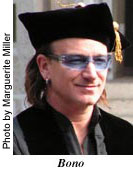
Bono and Poverty

This speech I listened to and found to be most inspiring, simple, beautiful, and true. Taken from Penn's Almanac website, http://www.upenn.edu/almanac/between/2004/commence-b.html

Commencement Address by Bono, co-founder of DATA (Debt AIDS Trade Africa), and lead singer of U2, May 17, 2004.

Because We Can, We Must

My name is Bono and I am a rock star. Don't get me too excited because I use four letter words when I get excited. I'd just like to say to the parents, your children are safe, your country is safe, the FCC has taught me a lesson and the only four letter word I'm going to use today is P-E-N-N. Come to think of it 'Bono' is a four-letter word. The whole business of obscenity--I don't think there's anything certainly more unseemly than the sight of a rock star in academic robes. It's a bit like when people put their King Charles spaniels in little tartan sweats and hats. It's not natural, and it doesn't make the dog any smarter.

It's true we were here before with U2 and I would like to thank them for giving me a great life, as well as you. I've got a great rock and roll band that normally stand in the back when I'm talking to thousands of people in a football stadium and they were here with me, I think it was seven years ago. Actually then I was with some other sartorial problems. I was wearing a mirror-ball suit at the time and I emerged from a forty-foot high revolving lemon. It was sort of a cross between a space ship, a disco and a plastic fruit.

I guess it was at that point when your Trustees decided to give me their highest honor. Doctor of Laws, wow! I know it's an honor, and it really is an honor, but are you sure? Doctor of Law, all I can think about is the laws I've broken. Laws of nature, laws of physics, laws of the Commonwealth of Pennsylvania, and on a memorable night in the late seventies, I think it was Newton's law of motion...sickness. No, it's true, my resume reads like a rap sheet. I have to come clean; I've broken a lot of laws, and the ones I haven't I've certainly thought about. I have sinned in thought, word, and deed. God forgive me. Actually God forgave me, but why would you? I'm here getting a doctorate, getting respectable, getting in the good graces of the powers that be, I hope it sends you students a powerful message: Crime does pay.

So I humbly accept the honor, keeping in mind the words of a British playwright, John Mortimer it was, "No brilliance is needed in the law. Nothing but common sense and relatively clean fingernails." Well at best I've got one of the two of those.

But no, I never went to college, I've slept in some strange places, but the library wasn't one of them. I studied rock and roll and I grew up in Dublin in the '70s, music was an alarm bell for me, it woke me up to the world. I was 17 when I first saw The Clash, and it just sounded like revolution. The Clash were like, "This is a public service announcement--with guitars." I was the kid in the crowd who took it at face value. Later I learned that a lot of the rebels were in it for the T-shirt. They'd wear the boots but they wouldn't march. They'd smash bottles on their heads but they wouldn't go to something more painful like a town hall meeting. By the way I felt like that myself until recently.

I didn't expect change to come so slow, so agonizingly slow. I didn't realize that the biggest obstacle to political and social progress wasn't the Free Masons, or the Establishment, or the boot heal of whatever you consider 'the Man' to be, it was something much more subtle. As the Provost just referred to, a combination of our own indifference and the Kafkaesque labyrinth of 'no's you encounter as people vanish down the corridors of bureaucracy.

So for better or worse that was my education. I came away with a clear sense of the difference music could make in my own life, in other peoples' lives if I did my job right. Which if you're a singer in a rock band means avoiding the obvious pitfalls like, say, a mullet hairdo. If anyone here doesn't know what a mullet is by the way your education's certainly not complete, I'd ask for your money back. For a lead singer like me, a mullet is, I would suggest, arguably more dangerous than a drug problem. Yes, I had a mullet in the '80s.

Now this is the point where the members of the faculty start smiling uncomfortably and thinking maybe they should have offered me the honorary bachelors degree instead of the full blown doctorate, (he should have been the bachelor's one, he's talking about mullets and stuff). If they're asking what on earth I'm doing here, I think it's a fair question. What am I doing here? More to the point: what are you doing here? Because if you don't mind me saying so this is a strange ending to an Ivy League education. Four years in these historic halls thinking great thoughts and now you're sitting in a stadium better suited for football listening to an Irish rock star give a speech that is so far mostly about himself. What are you doing here?

Actually I saw something in the paper last week about Kermit the Frog giving a commencement address somewhere. One of the students was complaining, "I worked my ass off for four years to be addressed by a sock?" You have worked your ass off for this. For four years you've been buying, trading, and selling, everything you've got in this marketplace of ideas. The intellectual hustle. Your pockets are full, even if your parents' are empty, and now you've got to figure out what to spend it on.

Well, the going rate for change is not cheap. Big ideas are expensive. The University has had its share of big ideas. Benjamin Franklin had a few, so did Justice Brennen and in my opinion so does Judith Rodin. What a gorgeous girl. They all knew that if you're gonna be good at your word if you're gonna live up to your ideals and your education, its' gonna cost you.

So my question I suppose is: What's the big idea? What's your big idea? What are you willing to spend your moral capital, your intellectual capital, your cash, your sweat equity in pursuing outside of the walls of the University of Pennsylvania?

There's a truly great Irish poet his name is Brendan Kennelly, and he has this epic poem called the Book of Judas, and there's a line in that poem that never leaves my mind, it says: "If you want to serve the age, betray it." What does that mean to betray the age?

Well to me betraying the age means exposing its conceits, it's foibles; it's phony moral certitudes. It means telling the secrets of the age and facing harsher truths.

Every age has its massive moral blind spots. We might not see them, but our children will. Slavery was one of them and the people who best served that age were the ones who called it as it was--which was ungodly and inhuman. Ben Franklin called it what it was when he became president of the Pennsylvania Abolition Society.

Segregation. There was another one. America sees this now but it took a civil rights movement to betray their age. And 50 years ago the U.S. Supreme Court betrayed the age May 17, 1954, Brown vs. Board of Education came down and put the lie to the idea that separate can ever really be equal. Amen to that.

Fast forward 50 years. May 17, 2004. What are the ideas right now worth betraying? What are the lies we tell ourselves now? What are the blind spots of our age? What's worth spending your post-Penn lives trying to do or undo? It might be something simple.

It might be something as simple as our deep down refusal to believe that every human life has equal worth. Could that be it? Could that be it? Each of you will probably have your own answer, but for me that is it. And for me the proving ground has been Africa.

Africa makes a mockery of what we say, at least what I say, about equality and questions our pieties and our commitments because there's no way to look at what's happening over there and it's effect on all of us and conclude that we actually consider Africans as our equals before God. There is no chance.

An amazing event happened here in Philadelphia in 1985--Live Aid--that whole We Are The World phenomenon the concert that happened here. Well after that concert I went to Ethiopia with my wife, Ali. We were there for a month and an extraordinary thing happened to me. We used to wake up in the morning and the mist would be lifting we'd see thousands and thousands of people who'd been walking all night to our food station were we were working. One man--I was standing outside talking to the translator--had this beautiful boy and he was saying to me in Amharic, I think it was, I said I can't understand what he's saying, and this nurse who spoke English and Amharic said to me, he's saying will you take his son. He's saying please take his son, he would be a great son for you. I was looking puzzled and he said, "You must take my son because if you don't take my son, my son will surely die. If you take him he will go back to Ireland and get an education." Probably like the ones we're talking about today. I had to say no, that was the rules there and I walked away from that man, I've never really walked away from it. But I think about that boy and that man and that's when I started this journey that's brought me here into this stadium.

Because at that moment I became the worst scourge on God's green earth, a rock star with a cause. Christ! Except it isn't the cause. Seven thousand Africans dying every day of preventable, treatable disease like AIDS? That's not a cause, that's an emergency. And when the disease gets out of control because most of the population live on less than one dollar a day? That's not a cause, that's an emergency. And when resentment builds because of unfair trade rules and the burden of unfair debt, that are debts by the way that keep Africans poor? That's not a cause, that's an emergency. So--We Are The World, Live Aid, start me off it was an extraordinary thing and really that event was about charity. But 20 years on I'm not that interested in charity. I'm interested in justice. There's a difference. Africa needs justice as much as it needs charity.

Equality for Africa is a big idea. It's a big expensive idea. I see the Wharton graduates now getting out the math on the back of their programs, numbers are intimidating aren't they, but not to you! But the scale of the suffering and the scope of the commitment they often numb us into a kind of indifference. Wishing for the end to AIDS and extreme poverty in Africa is like wishing that gravity didn't make things so damn heavy. We can wish it, but what the hell can we do about it?

Well, more than we think. We can't fix every problem--corruption, natural calamities are part of the picture here--but the ones we can we must. The debt burden, as I say, unfair trade, as I say, sharing our knowledge, the intellectual copyright for lifesaving drugs in a crisis, we can do that. And because we can, we must. Because we can, we must. Amen.

This is the straight truth, the righteous truth. It's not a theory, it's a fact. The fact is that this generation--yours, my generation--that can look at the poverty, we're the first generation that can look at poverty and disease, look across the ocean to Africa and say with a straight face, we can be the first to end this sort of stupid extreme poverty, where in the world of plenty, a child can die for lack of food in it's belly. We can be the first generation. It might take a while, but we can be that generation that says no to stupid poverty. It's a fact, the economists confirm it. It's an expensive fact but, cheaper than say the Marshall Plan that saved Europe from communism and fascism. And cheaper I would argue than fighting wave after wave of terrorism's new recruits. That's the economics department over there, very good.

It's a fact. So why aren't we pumping our fists in the air and cheering about it? Well probably because when we admit we can do something about it, we've got to do something about it. For the first time in history we have the know how, we have the cash, we have the lifesaving drugs, but do we have the will?

Yesterday, here in Philadelphia, at the Liberty Bell, I met a lot of Americans who do have the will. From arch-religious conservatives to young secular radicals, I just felt an incredible overpowering sense that this was possible. We're calling it the ONE campaign, to put an end to AIDS and extreme poverty in Africa. They believe we can do it, so do I.

I really, really do believe it. I just want you to know, I think this is obvious, but I'm not really going in for the warm fuzzy feeling thing, I'm not a hippy, I do not have flowers in my hair, I come from punk rock, The Clash wore army boots not Birkenstocks. I believe America can do this! I believe that this generation can do this. In fact I want to hear an argument about why we shouldn't.

I know idealism is not playing on the radio right now, you don't see it on TV, irony is on heavy rotation, the knowingness, the smirk, the tired joke. I've tried them all out but I'll tell you this, outside this campus--and even inside it--idealism is under siege beset by materialism, narcissism and all the other isms of indifference. Baggism, Shaggism. Raggism. Notism, graduationism, chismism, I don't know. Where's John Lennon when you need him.

But I don't want to make you cop to idealism, not in front of your parents, or your younger siblings. But what about Americanism? Will you cop to that at least? It's not everywhere in fashion these days, Americanism. Not very big in Europe, truth be told. No less on Ivy League college campuses. But it all depends on your definition of Americanism.

Me, I'm in love with this country called America. I'm a huge fan of America, I'm one of those annoying fans, you know the ones that read the CD notes and follow you into bathrooms and ask you all kinds of annoying questions about why you didn't live up to thatŠ.

I'm that kind of fan. I read the Declaration of Independence and I've read the Constitution of the United States, and they are some liner notes, dude. As I said yesterday I made my pilgrimage to Independence Hall, and I love America because America is not just a country, it's an idea. You see my country, Ireland, is a great country, but it's not an idea. America is an idea, but it's an idea that brings with it some baggage, like power brings responsibility. It's an idea that brings with it equality, but equality even though it's the highest calling, is the hardest to reach. The idea that anything is possible, that's one of the reasons why I'm a fan of America. It's like hey, look there's the moon up there, lets take a walk on it, bring back a piece of it. That's the kind of America that I'm a fan of.

In 1771 your founder Mr. Franklin spent three months in Ireland and Scotland to look at the relationship they had with England to see if this could be a model for America, whether America should follow their example and remain a part of the British Empire.

Franklin was deeply, deeply distressed by what he saw. In Ireland he saw how England had put a stranglehold on Irish trade, how absentee English landlords exploited Irish tenant farmers and how those farmers in Franklin's words "lived in retched hovels of mud and straw, were clothed in rags and subsisted chiefly on potatoes." Not exactly the American dream...

So instead of Ireland becoming a model for America, America became a model for Ireland in our own struggle for independence.

When the potatoes ran out, millions of Irish men, women and children packed their bags got on a boat and showed up right here. And we're still doing it. We're not even starving anymore, loads of potatoes. In fact if there's any Irish out there, I've breaking news from Dublin, the potato famine is over you can come home now. But why are we still showing up? Because we love the idea of America.

We love the crackle and the hustle, we love the spirit that gives the finger to fate, the spirit that says there's no hurdle we can't clear and no problem we can't fix. (sound of helicopter) Oh, here comes the Brits, only joking. No problem we can't fix. So what's the problem that we want to apply all this energy and intellect to?

Every era has its defining struggle and the fate of Africa is one of ours. It's not the only one, but in the history books it's easily going to make the top five, what we did or what we did not do. It's a proving ground, as I said earlier, for the idea of equality. But whether it's this or something else, I hope you'll pick a fight and get in it. Get your boots dirty, get rough, steel your courage with a final drink there at Smoky Joe's, one last primal scream and go.

Sing the melody line you hear in your own head, remember, you don't owe anybody any explanations, you don't owe your parents any explanations, you don't owe your professors any explanations. You know I used to think the future was solid or fixed, something you inherited like an old building that you move into when the previous generation moves out or gets chased out.

But it's not. The future is not fixed, it's fluid. You can build your own building, or hut or condo, whatever; this is the metaphor part of the speech by the way.

But my point is that the world is more malleable than you think and it's waiting for you to hammer it into shape. Now if I were a folksinger I'd immediately launch into "If I Had a Hammer" right now get you all singing and swaying. But as I say I come from punk rock, so I'd rather have the bloody hammer right here in my fist.

That's what this degree of yours is, a blunt instrument. So go forth and build something with it. Remember what John Adams said about Ben Franklin, "He does not hesitate at our boldest Measures but rather seems to think us too irresolute."

Well this is the time for bold measures. This is the country, and you are the generation. Thank you.

Posted 5/19/04

Wednesday, October 11, 2006

Nicaraguan Rundown from Corn Island

What is rundown? Originally from the Caribbean, this process takes coconut and produces coconut custard and oil by boiling the milk down. A full recipe is found:

http://eatjamaican.com/recipes/traditional-Jamaican-coconut-rundown-recipe.html

on the EatJamaican.com website (accessed 11 Oct 2006).

Interestingly enough, this recipe is also used in many Nicaraguan dishes from the Atlantic Coast and can be mixed with breadfruit, meat, fish, and vegetables. Immigrants from African origin came to the country from the Caribbean when they were working on plantations and brought many tropical foods along with them.

Something I was not aware of is that many people from the Atlantic Coast may speak English and Creole and not a word of Spanish!...or very poor Spanish. Such is the cultural separation between the coast and the city. This separation is followed in politics and economics of the country.

Should the building of the interoceanic canal take place, I can imagine the coast receiving a much needed economic boost.

Palms Food: Nicaragua

Cajeta De Coco

2 cups condensed milk

1 cup fresh shredded coconut

1 cup butter or margarine

1/2 teaspoon vanilla


Directions:

Combine all ingredients in a saucepan and bring to a boil. Keep mixing with a wooden spoon until you see the bottom of the pan while you mix. Form them into small balls and store them in a refrigerator--if you don't eat them all.

Tuesday, October 03, 2006

Nicaragua: A Second Panama Canal?

The President of Nicaragua, Bolanos, proposed on Monday the international support to construct a second canal, wider than Panama, in response to "the world's booming shipping business." (1)

This project would cost no less than US$18 billion and would take approximately 12 yrs to build. If you've ever visited Panama and Nicaragua, the stark contrast between the two countries cannot escape one's eyes. Panama is a small Europe with adorable crepe restaurants and the possibility of frolicking about in the city. This prosperity is largely if not entirely due to the building of the canal, originally plannd to be constructed in Nicaragua.

People in Nicaragua are living in the third poorest country in Latin America and it shows. The economic benefits for such a country from the building of the canal would be tremendous. Nicaragua, however, a country of beautiful people, is torn by a political corruption that has surpassed the acceptable levels we all tolerate, regardless of the country we live in or the form in which the corruption is perceived. How will this corruption encourage the level of investment required to build the canal? This will have to be addressed and, frankly, I am uncertain as to what a solution would be.

Panamians are pitching to expand their canal to reduce the traffic it currently experiences and in order to be able to compete internationally in the case a Nicaraguan canal is built. The public believes this move will pass quite easily.

It makes me sad to see Nicaragua struggling to move forward and the country is, to be blunt, so much in the shits that only a tremendous and prosperous undertaking like the building of a canal could push its economy forward in a reasonable amount of time.


1. "Nicaraguan Presidnet proposes second canal to complement Panama's." International Herald Tribune 2 Oct. 2006: IHT.com 3 Oct 2006 http://www.iht.com/articles/ap/2006/10/03/america/LA_GEN_Nicaragua_Canal.php

Coconut: A Perplexing Nut

It seems in India, according to The Hindu in its article on coconut oil (1) , the coconut oil industry has "lost glory." Coconut oil producers are not sufficiently protected by the market.
There has been generally a drop in products that contain fatty acids, thus affecting this product's rate of import. Import tariff's on palm oil and polyolefin has decreased, which means that the import of these competing oils take business away from coconut oil producers. Prices of the oil fluctuate on a daily basis. In response, coconut oil has been mixed with lower quality ingredients when coconut oil prices are high and falsely sold to consumers.


In Vietnam, the coconut industry also does not sufficiently protect the producers (2). The article about Vietnam, however, does not focus on the problems associated with the production of coconut oil but of those associated with any processing of the coconut. Producers experience competition from two sides because of tremendous demand. The growers sell the fruit at high prices because of the high demand to ship it to China, Thailand, and Cambodia.

What can we say about all this? Firstly, I adore coconut milk. My Brazilian friend the other day took coconut milk, condensed milk, and...I added some water to this sinful drink...and it was one of the best things I'd ever had. The point: Coconut is so damn good I see why it causes so many problems.

A tad more seriously, from the reading it seems that the coconut market in India has affected it internally (as Indians struggle with the rising price of coconut oil) and with the exportation of coconut oil (as the demand for coconut oil has fallen). The Vietnan coconut industry, on the other hand, is flourishing on an international front as the demand to import its coconuts is on the rise but is suffering internally as producers find themselves competing with international buyers for raw coconut product.

Does this mean that perhaps India should stop processing coconuts in order to extract coconut oil because it seems the demand is higher for copra, the raw coconut meat, in the international market? Does this mean that Vietnam should allow the national coconut prices to be solely regulated by the international market's demand? Neither solution takes into consideration the producers, who are suffering, for different reasons but in similar ways, by the demands for coconut and its products in the international market.

I wonder if the demands by the international market, increasingly a more healthy market, will continue to favor the raw, unprocessed coconut rather than its less healthy byproducts such as coconut oil--unfavorable for India.

Ideas, suggestions,...would be highly appreciated. The problem with the coconut in India and Vietnam can be compared to many crops whose prices become high in the local market.


References:
1. "Better deal for coconut oil sector demanded." The Hindu 22 Sept 2006: Hindu.com 3 Oct 2006 http://www.hindu.com/2006/09/22/stories/2006092209012100.htm

2. "Coconut price soar, growers get rich, producers starve." VietNamNet 28 Sept 2006: Vietnamnet.vn 3 Oct 2006 http://english.vietnamnet.vn/biz/2006/09/616734/


Monday, September 25, 2006

Coconut News

Indian elephants suffer

"Entrepreneurs hire elephants to split open a coconut at the inauguration of a new store."

This sounds entertaining, and no doubt it is, but elephants are mistreated and abused in India. It is not only people that suffer but these beautiful animals as well. Apparently, elephants are in large Indian cities for religious reasons as they are sacred animals and are used for blessings at festivals.

This fascinating article draws a parrallel line between the life path of elephants and many poor Indian people in cities. They are migrants who will do much for a few rupees. The city too does not provide sufficient nutrition and water for its inhabitants, including elephants. What is sadly highlighted in this tale is how a society where its people have a low standard of living will consequently have animals that suffer as well.

There is some comfort to having a pet in a poor person's life. I remember in Ecuador there were many poor families that kept dogs or cats even though they didn't have enough food to nourish themselves. This I found odd and sad in many ways but empathized with the warmth a pet can bring to a home.

In Nicaragua, I witnessed the same but learned that dogs are kept in order to warn of and frighten away burglars. Crime has become a reality for most Nicaraguans and they feel the cost of keeping a dog, which is relatively low as they are often underfed, is a safe investment. The common occurence of dog poisoning only hightlights this fact. Dogs have to be better protected, I thought.

Closing thoughts: as entertaining as an elephant with coconuts might be, as cozy as we might feel with a pet at home, or as necessary as a pet might be for the safety of a family, the importance of respecting an animal's life goes hand in hand with respecting that of a human being.

Wednesday, September 06, 2006

Palms Foods: Ecuador

Tomato Soup with Plantains

Ingredients

-8 medium tomatoes
-2 cups chicken stock
-1/2 tsp of salt
-2 tbsp vegetable oil
-2 onions--finely chopped
-2 plantains
-1tbsp cornstarch
-1/4 cup coconut milk
-dash white pepper

Directions:

In large saucepan, combine tomatoes, stock and salt. Bring to a boil - cover and simmer over low heat until tomatoes are soft.
Heat oil in saucepan. Add onions - saute until transparent. Peel and slice plantains. Add plantain slices to sauteed onions. Saute - crushing slightly.

Strain tomato pulp through strainer - or puree in a blender or food processor. Stir puree into onion mixture.

In bowl, combine cornstarch and coconut milk. Stir in about 1/4 cup hot tomato soup. Stir cornstarch mixture into remaining soup.

Stir constantly over low heat until soups thickens slightly. Season with white pepper. Pour into a tureen or serve in individual bowls.

Sunday, July 30, 2006

Palms is Up and Running

Hello,

I am the Executive Director of Palms for Life Fund, a new not-for-profit organization in the United States (with a 501(c)(3) status) that helps poor people overcome poverty by addressing some of its root causes. Our main focus is on educating and feeding schoolchildren, ensuring the health of mothers and infants, developing adult literacy and work skills and empowering local organizations.

Please visit our website at www.palmsforlifefund.org , give us your feedback, and consider making a donation. You can also write to me (hannah.laufer@palmsforlifefund.org) with information about local executing partners in the selected countries or to volunteer for working in those countries.

What is special about Palms is our team of experts who currently reside or have lived in poor countries in Africa, Asia and Latin America and know what poor and hungry people experience every day of their lives. Our only motivation is to make a difference, by advocating for the poor and raising funds to support projects that will make a long-lasting difference.

Now we are small, but we will grow in numbers of Friends that help Palms and numbers of people that get help from Palms. Please support our mission so that we can provide poor people with opportunities to get out of poverty.

Awaiting your visit to Palms for Life Fund.

Hannah